2027 Elections: Rising Campaign Costs Raise Concerns Over Fair Political Competition in Nigeria
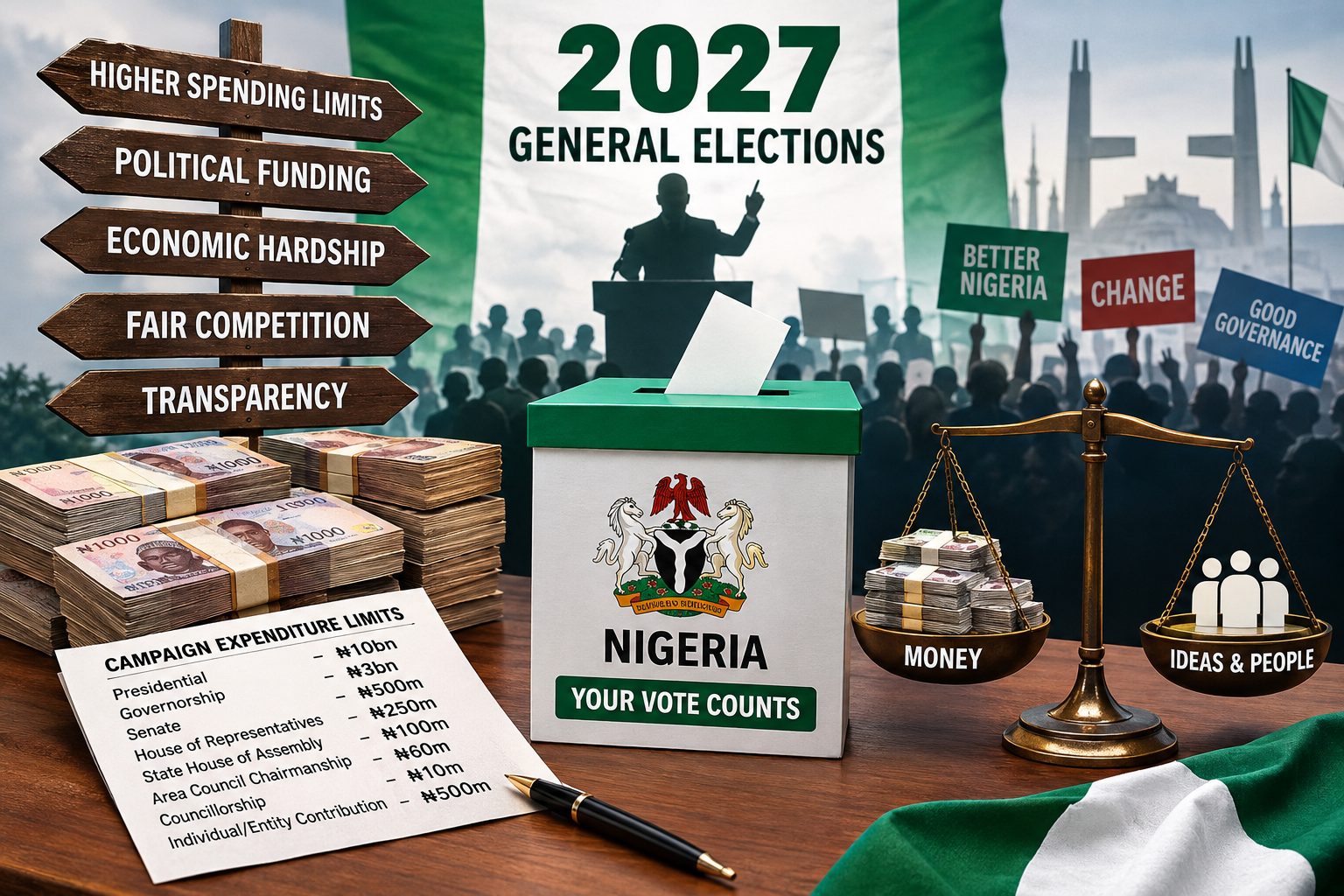
2027: Campaign Funding and the Challenge of Fair Elections in Nigeria
Nigeria’s 2027 general elections are expected to generate intense political competition as parties prepare to present their candidates and convince voters to support their programmes. However, beyond the struggle for political power, campaign financing is emerging as an important issue that could influence the ability of political parties to compete fairly. Opposition parties have expressed concerns about their financial capacity to challenge the ruling All Progressives Congress (APC), particularly at a time when economic hardship is affecting households, businesses and potential political donors across the country.
The debate has become more significant following the increase in campaign expenditure limits under the Electoral Act 2026. Although the revised limits provide candidates with greater financial room to organise campaigns, they also raise questions about the influence of money on Nigeria’s democratic process. The central concern is whether political competition will be determined by the quality of candidates and their ideas or increasingly shaped by the financial resources available to their parties.
Under the Electoral Act 2026, the maximum campaign expenditure for presidential candidates has increased from ₦5bn to ₦10bn. The limit for governorship candidates has risen from ₦1bn to ₦3bn, while senatorial candidates can spend up to ₦500m, compared with the previous limit of ₦100m. Candidates contesting seats in the House of Representatives can now spend up to ₦250m, against the former limit of ₦70m.
Similarly, the spending ceiling for State House of Assembly candidates has increased to ₦100m from ₦30m. Area Council chairmanship candidates can spend up to ₦60m, while the limit for councillorship candidates has risen to ₦10m. The maximum contribution an individual or entity may make to a political party or candidate has also increased from ₦50m to ₦500m.
These figures represent maximum permitted expenditure rather than compulsory spending. Nevertheless, the increases raise questions about how political parties will finance their activities and whether the new limits could widen the gap between parties with access to substantial financial resources and those that depend on smaller donations.
Campaigns require funding for transportation, campaign offices, publicity, rallies, communication, election materials and the mobilisation of party supporters. Candidates also need resources to communicate their manifestos to voters across different communities. In a country as large and diverse as Nigeria, these activities can be expensive.
However, when campaign financing becomes excessively dependent on wealth, political participation may become more difficult for candidates who have limited access to wealthy individuals, corporate donors or influential networks.
Nigeria’s economic situation presents an additional challenge for political parties seeking financial support. Many households are dealing with the rising cost of food, transportation, housing, education and healthcare. Small businesses are also facing financial pressures, making it more difficult for ordinary citizens and entrepreneurs to contribute to political campaigns.
For opposition parties, the challenge may be particularly serious if their fundraising depends largely on voluntary donations from individuals who are themselves struggling economically. While wealthy political supporters may be able to make substantial contributions, smaller donors may have little money available after meeting their basic needs.
This situation raises an important question about the relationship between economic inequality and political participation. If political parties increasingly depend on wealthy donors, citizens with limited financial resources may have fewer opportunities to support the political movements that represent their interests.
Nevertheless, financial challenges should not automatically prevent opposition parties from participating effectively in elections. Transparent grassroots fundraising, membership contributions, digital campaigns and community engagement can help parties mobilise support without depending entirely on a small group of wealthy financiers.
The effectiveness of these alternatives, however, will depend on the ability of political parties to build public trust and demonstrate that their programmes address the needs of ordinary Nigerians.
Another issue raised in the campaign funding debate is the potential financial advantage enjoyed by a party controlling the federal government. Opposition groups have expressed concerns that the APC may have greater access to financial resources than its competitors. They have also alleged that economic hardship and fear of political reprisals could discourage some potential donors from supporting opposition parties.
These allegations should be examined carefully and supported by credible evidence. Being the ruling party does not, by itself, establish that a party has violated electoral laws or improperly obtained campaign funds. However, the concerns highlight the importance of ensuring that public resources are not used to create an unfair advantage for any political organisation.
In a democratic system, the party in government and opposition parties should be able to present their policies to voters within a framework of fair competition. Public institutions must remain impartial, and the use of government facilities, personnel or public funds for partisan purposes should be subject to appropriate legal restrictions and oversight.
The ability of opposition parties to organise, raise legitimate funds and communicate their ideas is important to democratic accountability. Opposition parties provide voters with alternative policy proposals and give citizens the opportunity to evaluate different approaches to governance.
If financial barriers prevent parties from reaching voters effectively, the range of choices available to the electorate could be weakened. For this reason, campaign finance rules should promote transparency and accountability without unnecessarily restricting legitimate political participation.
The increase in the maximum contribution an individual or entity can make to a political party or candidate from ₦50m to ₦500m is another significant development.
Large donations can help political parties finance legitimate campaign activities. However, substantial contributions from a small number of wealthy individuals or organisations may create concerns about the influence donors could exercise over political decisions.
Candidates who rely heavily on major financiers may face pressure, whether direct or indirect, to consider their donors’ interests when making appointments, awarding contracts or developing policies after winning elections. Such outcomes are not inevitable, but the possibility makes transparency in political financing especially important.
As PUNCH has highlighted in its coverage of the 2027 campaign funding debate, opposition parties are concerned about their ability to compete financially with the ruling party. This discussion reinforces the need to examine how campaign financing affects political competition and whether the existing regulatory framework can guarantee a fair process.
Nigerians have a legitimate interest in knowing how political parties raise funds and whether their financial relationships create potential conflicts of interest. Transparent reporting can help citizens assess whether political financing complies with the law and whether parties are accountable to their members and supporters.
Political parties should therefore maintain accurate financial records, disclose contributions as required by law and establish internal procedures to prevent improper financial influence. Candidates should also explain how their campaign funds are raised and spent.
A credible system of campaign financing should allow legitimate donations while discouraging corruption, undisclosed funding and the misuse of public resources.
The Responsibility of INEC and Other Institutions
The Independent National Electoral Commission (INEC) has an important role to play in promoting compliance with campaign finance regulations. As preparations for the 2027 elections continue, effective monitoring and enforcement will be essential to maintaining public confidence.
INEC should ensure that political parties and candidates comply with the applicable expenditure limits and financial reporting requirements. Where the law requires the submission of campaign finance statements, these records should be examined appropriately, and violations should attract the consequences provided by law.
The commission should also provide clear guidance on campaign finance obligations so that political parties understand the rules governing donations, expenditure and financial disclosures.
Transparency alone is not sufficient if violations are not investigated or enforcement is inconsistent. Relevant institutions must therefore have the capacity to review financial records, investigate credible complaints and take appropriate action when evidence establishes a breach of the law.
Anti-corruption agencies may also have a role where credible evidence points to corruption, unlawful financial arrangements or the misuse of public resources. Their actions should be based on evidence and follow due process rather than political considerations.
Furthermore, citizens, journalists and civil society organisations can contribute to accountability by monitoring campaign activities, reporting credible concerns and educating voters about the rules governing political financing.
Although opposition parties face financial challenges, they can explore alternative ways of reaching voters. One option is grassroots fundraising, which allows supporters to contribute smaller amounts voluntarily. While such contributions may not immediately generate the resources available to wealthy political organisations, they can broaden participation and reduce dependence on a few major donors.
Town hall meetings and community consultations can also help parties communicate directly with voters. Rather than concentrating resources on expensive rallies, parties can organise discussions where candidates explain their policies and respond to questions from residents.
Digital platforms offer another opportunity to distribute campaign messages, publish manifestos and engage supporters. These approaches may reduce some communication costs, although they cannot entirely replace the resources required for nationwide campaigning or reach every community equally.
Political alliances may also enable parties with shared objectives to coordinate aspects of their political activities, provided their arrangements comply with electoral laws.
Most importantly, opposition parties must demonstrate accountability in their own financial management. They should present clear policy proposals on inflation, unemployment, insecurity, education, healthcare and economic development. Voters need more than criticism of the ruling party; they also need credible alternatives and practical explanations of how proposed policies would be implemented.
The Role of Voters in Campaign Finance Accountability
Nigerian voters also have an important responsibility in determining the quality of political competition. Citizens should assess candidates according to their records, policy proposals, integrity and understanding of the challenges facing their communities.
Campaign spending and large rallies may attract public attention, but they do not necessarily demonstrate that a candidate can govern effectively. Voters should examine whether candidates explain how they intend to address problems such as the rising cost of living, unemployment, insecurity, poor infrastructure and limited access to essential services.
Citizens should also be cautious about financial inducements during elections. When voters are pressured or persuaded to exchange their electoral choices for immediate material benefits, the broader public interest may be undermined.
Civil society organisations, community leaders and the media can support informed participation by providing accurate information about candidates, campaign financing and electoral regulations. Public education should emphasise the importance of evaluating policies rather than allowing campaign expenditure alone to shape political judgments.
The debate over campaign financing ahead of Nigeria’s 2027 general elections highlights the need to balance legitimate campaign expenditure with fairness, transparency and accountability. Increasing spending limits does not automatically mean that elections will become unfair, but the changes make effective regulation and public scrutiny particularly important.
The APC and opposition parties should be subject to the same applicable legal standards, and campaign finance rules should be enforced consistently. Political donations should be transparent, expenditure should be properly documented, and allegations of misconduct should be investigated impartially.
The Policy and Legal Advocacy Centre (PLAC) also provides a useful legal and policy perspective on campaign finance and expenditure limits under the Electoral Act 2026. Its work can help inform public discussion about political donations, spending ceilings and the importance of effective regulation.
As Nigeria prepares for another general election, the priority should be to ensure that financial resources do not become an insurmountable barrier to legitimate political competition. Political parties must demonstrate accountability, institutions must enforce the law, and voters must have access to reliable information about the candidates seeking their support.
Ultimately, the credibility of the 2027 elections will depend not simply on how much political parties spend, but on whether the process allows Nigerians to make informed choices freely and fairly. A democratic system is strengthened when candidates compete through credible ideas, clear policy commitments and public accountability rather than financial power alone.
References
PUNCH Newspapers: Official PUNCH website — News coverage of campaign financing and opposition parties’ concerns ahead of the 2027 general elections.
Policy and Legal Advocacy Centre (PLAC): Official PLAC website — Legal and policy resources on electoral reform, campaign financing and election expenditure regulations in Nigeria.
Sources
Version 1.0. 54gist stories are edited before publication and updated as facts change. Spotted an error? Tell our editors.