World News: Why Africans Should Always Do Quick Viral Video Checks
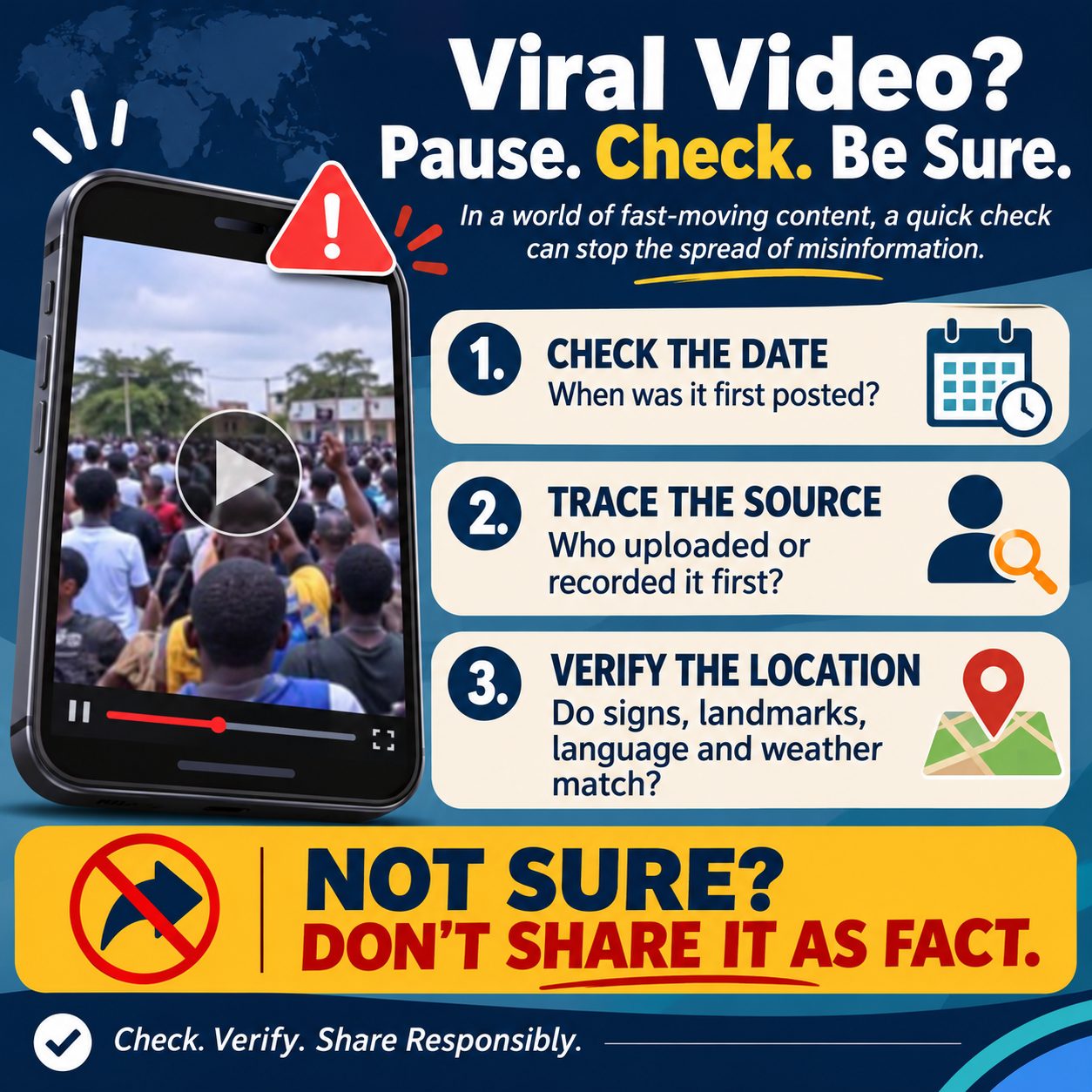
A video can appear on WhatsApp, TikTok, Facebook or X and reach thousands of people within minutes. Sometimes, it captures a genuine event and provides useful information. At other times, it tells an entirely different story from what actually happened.
Across Africa, where social media has become an important source of news and public information, the speed at which videos circulate makes verification increasingly important. A clip showing a building on fire, a public protest, an alleged security incident or a dramatic political statement can quickly attract attention. However, the video may be old, recorded in another country or edited to support a misleading claim.
This is why Africans should develop the habit of checking viral videos before believing or sharing them. It does not require professional journalism skills or expensive equipment. A few simple steps can help ordinary social media users avoid spreading misinformation.
##Why Viral Videos Can Be Misleading
Not every misleading video is completely fabricated. In fact, some of the most convincing examples involve genuine footage presented with a false caption.
For instance, a video recorded during a protest several years ago could be reposted with a caption claiming that a similar protest is happening today in another African country. Because the footage looks real, viewers may accept the new explanation without questioning it.
Other videos may be edited to remove important details, combined with unrelated audio or generated using artificial intelligence (AI). In some cases, an original video is reposted so many times that the identity of the person who recorded it and the actual location become difficult to establish.
The danger is that people often react emotionally before checking the information. This can encourage unnecessary panic, increase tension between communities and damage the reputation of individuals or organisations.
A useful starting point is to remember that a genuine-looking video does not automatically mean its caption is true.
##A Simple Method for Checking Viral Videos
You do not have to be a professional fact-checker to investigate a suspicious video. A simple three-step approach can help you determine whether a clip deserves your attention.
- Check the date: When was the video first posted? The first question should be whether the video is actually recent.
Do not rely only on the date written in the caption. Search for the video using a few distinctive words from its description. You can also take screenshots of clear moments in the clip and search for them using Google Lens or other reverse-image search tools.
If the same footage appears in an older news report or social media post, compare the original caption and publication date with the new claim.
A video posted today is not necessarily a video recorded today. Someone could have downloaded an old recording and uploaded it again with a new explanation.
- Check the source account: Who originally shared it? The account that forwarded a video to you may not be the person who recorded it.
Look for watermarks, usernames, photographer credits or references to the original uploader. If possible, visit the account's page and examine its previous posts.
Ask yourself:
Does the account regularly publish content from the location it claims to represent?
Is there a link to the original recording?
Does the account provide any evidence or simply make dramatic claims?
Have credible news organisations or independent sources reported the same incident?
Be careful with accounts that have little history, no identifiable background or a pattern of sharing sensational content without evidence.
A large follower count does not automatically make an account trustworthy.
- Check the location: Do the surroundings match the claim? This is particularly important when videos are shared across African countries.
Look closely at:
- Road signs, street names and shop advertisements.
- Languages spoken in the video.
- Buildings, landmarks and the general environment.
- Police or emergency service uniforms, where relevant.
- Weather conditions, lighting and shadows.
For example, if a video is said to show flooding in Ibadan, check whether the road layout, buildings and visible landmarks resemble the claimed location. You can compare these details with Google Maps, Google Earth or other publicly available images.
These clues may not provide a final answer individually, but when several details match, they can help establish whether the location is credible.
Africa Check recommends examining location clues and comparing them with maps and other available evidence. Its guidance also warns against sharing breaking-news footage without first establishing its context.
##WhatTheFact and Other Places to Find Verification Updates
Fortunately, social media users do not have to investigate every viral video entirely on their own. Several fact-checking organisations publish investigations, corrections and explanations that can help people understand what is circulating online.
One useful example is WhatTheFact. Its published investigations demonstrate how genuine videos can be presented with misleading descriptions.
In an October 28, 2026 investigation, WhatTheFact examined a video shared on X that allegedly showed the aftermath of a recent Houthi bombing in Riyadh, Saudi Arabia. The investigation found that although the footage appeared to show a real fire, there was insufficient evidence connecting it to the alleged attack. The video was therefore classified as misleading.
##What the Fact
What makes this example important is that the footage did not necessarily have to be completely fabricated to mislead viewers. The problem was the connection made between the video and the claimed event.
WhatTheFact also referenced SouthCheck, another fact-checking organisation, in its investigations. SouthCheck examines viral social media claims, misleading images and videos, and other public-interest information. Its methodology includes reverse-image searches, metadata analysis, satellite imagery and independent editorial review.
These organisations publish their findings through their websites and, in many cases, their social media accounts. Users can search their platforms using keywords from a suspicious video or the name of the event being discussed.
It is also important to read the actual investigation rather than relying on a screenshot of a fact-check verdict. Look at the evidence, the date of publication and whether the organisation has issued an update.
##What Should You Do Before Sharing a Viral Video?
Before forwarding a video to a WhatsApp group or reposting it on Instagram, take a moment to consider the possible consequences.
##Here are five habits worth developing:
- Pause before reacting: Avoid immediately forwarding videos that provoke anger, fear or excitement. Emotional reactions can make people overlook missing information.
- Search for independent confirmation: Check whether credible news organisations, official authorities or established fact-checkers have reported the incident. Do not mistake several accounts repeating the same original post for independent confirmation.
- Look for the complete video: Short clips can remove important moments that explain what actually happened. Try to locate the original or a longer version before accepting the accompanying explanation.
- Avoid presenting uncertainty as fact: If you cannot establish the video's original date, source or location, do not share it as confirmed news. You can wait for more information rather than contribute to the confusion.
- Correct misleading information when necessary: If you discover that a video you previously shared was misrepresented, correct your earlier post or send an explanation to the same groups where you shared it. Do not allow an inaccurate claim to continue circulating simply because you have already forwarded it.
It is also worth remembering that AI-detection tools are not perfect. A video that receives a suspicious score is not automatically fake, just as a video that appears natural is not necessarily genuine. Verification should involve examining the original source, context and supporting evidence.
##Responsible Sharing Is Everyone's Business
Misinformation is not only a problem for journalists, politicians or social media influencers. Ordinary internet users also play a role in determining how far misleading information travels.
Across Nigeria and other African countries, WhatsApp groups, Facebook communities and short-video platforms have become important spaces for sharing information. This makes responsible sharing particularly important, especially during elections, public emergencies, security incidents and other sensitive situations.
A simple verification habit can prevent unnecessary panic, protect innocent people from false accusations and encourage healthier online conversations.
Nobody expects every social media user to conduct a full investigation before watching a video. However, checking its date, tracing its source and examining its location are reasonable steps that most people can take.
The next time a dramatic video appears on your timeline, remember three things: check the date, trace the source and verify the location. If the evidence is insufficient, let the video wait.
Version 1.0. 54gist stories are edited before publication and updated as facts change. Spotted an error? Tell our editors.