One Outage Is No Longer Just An IT Problem
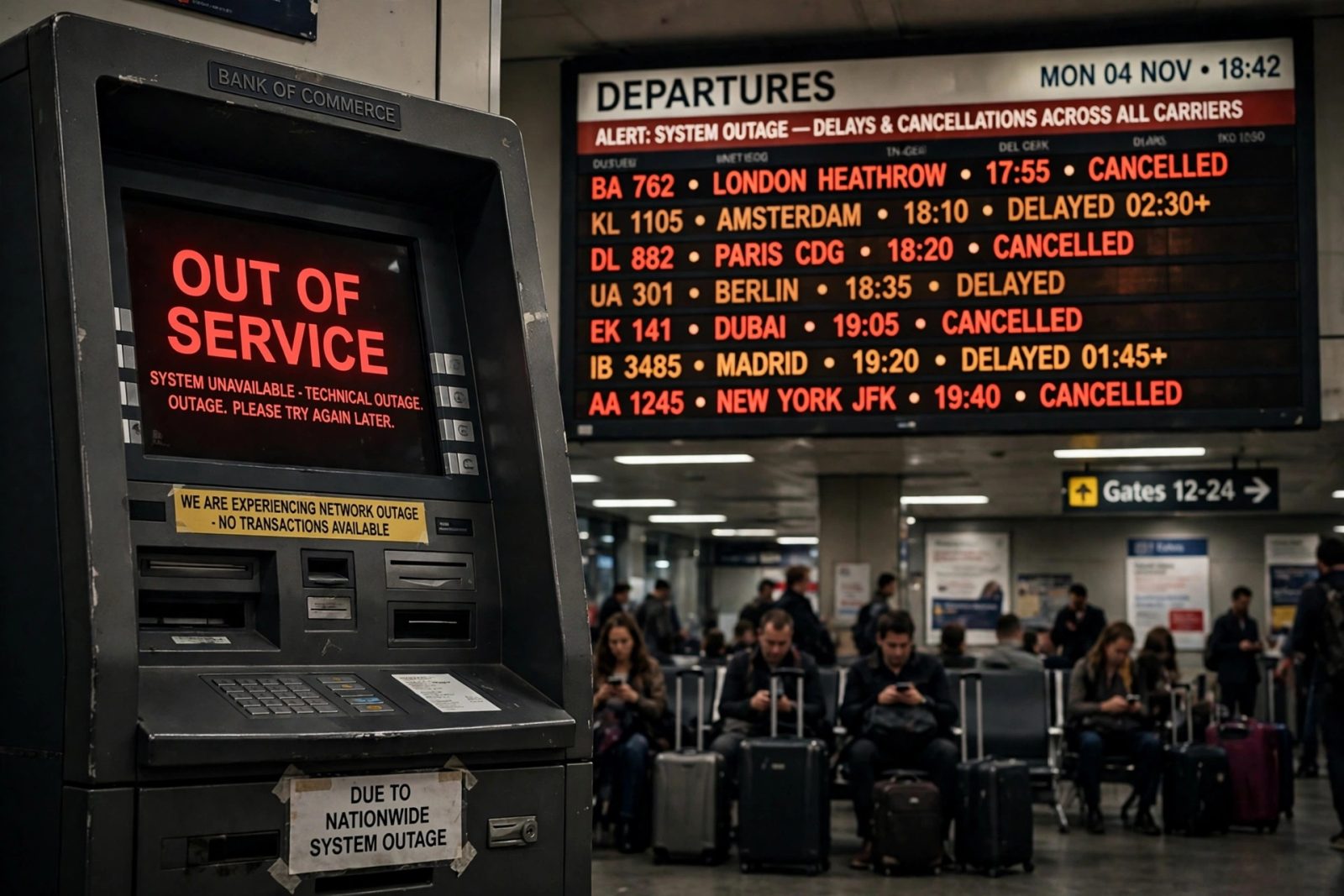
One Outage Is No Longer Just An IT Problem
When a flight is grounded, your bank app stops working, and your email won't load — all in the same week — it's easy to think something big and coordinated is happening.
According to coverage by the Associated Press, that is exactly what happened in the US in November 2026. In just six days, Microsoft, the Federal Aviation Administration (FAA), JPMorgan Chase, United Airlines, and Apple all suffered separate outages. Officials said there was "zero" indication they were linked or caused by a cyberattack.
Yet the effect felt connected. Because in today's world, it is.
One outage can now trigger bigger disruptions across many services like banking and travel. It's not just an IT issue anymore. It's a business, travel, and everyday-life issue.
The Simple Example: One Switch, Many Devices
Think of your house.
You have one main switch. It powers the lights, the fridge, the TV, the Wi-Fi router, and your phone charger.
If that one switch trips, everything goes off at once — even though the lights, fridge, and TV are completely different devices.
Modern technology works the same way.
Many companies share the same underlying "switches": the same cloud provider, the same payment network, the same identity/login service, the same software update, or the same telecom network.
When one of those shared switches fails, dozens of unrelated services fail with it.
That is called dependency. You may not depend on AWS, Microsoft, or Chase directly, but the app you use does. And when it fails, you feel it.
Real-World Example 1: The November 2026 Outage Week
AP News reported a rapid pile-up of failures:
- Microsoft - Nov. 12 Microsoft 365 went down, disrupting Outlook, Teams, and Copilot for millions of users in more than 70 countries. Microsoft linked it to a server upgrade and a network fix. *2. FAA - Nov. 13 A malfunction in the FAA's network triggered the longest nationwide flight grounding in 25 years — more than four hours. Airlines faced cancellations and delays for days as they tried to recover. 73f5
3. JPMorgan Chase - Nov. 16
A software bug in Chase's on-premises hardware system caused transaction delays. It didn't just affect Chase customers. People at other banks trying to send money to Chase accounts also saw delays, and Zelle payments were slowed. 7f51
- United Airlines - Nov. 16 On the same day, United had a separate system outage that delayed departing flights for more than 90 minutes. 7f51
- Apple and Marriott - Nov. 17 Apple said an internal update disrupted Apple Music, AppleCare, and the App Store. Marriott said technical problems prevented some customers from signing in. 3279
None of these were officially linked. But together, they showed how fragile the system feels when email, flights, banking, and shopping all wobble in the same week. Sen. Mark Warner called it "a wake-up call." 3279
Real-World Example 2: CrowdStrike, July 2024
This is still the clearest example of dependency in action.
One faulty software update from cybersecurity firm CrowdStrike crashed computers running Microsoft Windows around the world. Airlines, banks, hospitals, and media outlets were hit at the same time. 0012
The update was not a hack. It was a defect in a single content update. But because so many big companies in transportation, banking, and healthcare used the same security software, one bad update became a global outage.
Delta, United, and American Airlines grounded flights. Banks like Wells Fargo, Bank of America, and Chase reported problems. Hospitals had booking systems go offline.
One company. One update. Millions affected.
Real-World Example 3: AWS Outage, October 2025
On October 20, 2025, a glitch at an Amazon Web Services data center in northern Virginia took down 141 AWS services.
The cause was a failure in DNS — the internet's "phone book" that translates a website name into an address your computer can find. When DNS failed, apps couldn't find their databases.
The result:
- Banking: Customers of Lloyds, Halifax, and other banks couldn't complete transactions. Robinhood and Coinbase also had problems.
- Travel: Delta and United passengers couldn't check in online or retrieve seat assignments.
- Everyday apps: Snapchat, Roblox, Fortnite, Signal, Ring doorbells, and even Amazon's own site were affected.
A fault in Virginia disrupted a bank customer in London. That is dependency.
Real-World Example 4: Google Cloud, October 2026
TechRadar reported a similar pattern a year later. A "power event" in Google Cloud's London region caused a major outage across Europe. b87c
TechRadar noted that because Google Cloud is "the technological backbone for many other companies," the outage affected a range of customers. Banking apps like Revolut and Lloyds Bank showed spikes in outage reports at the same time.
One expert told TechRadar: "A problem in Google Cloud's London region is having a knock-on effect across banks, government services and retailers, because so many of them run on the same infrastructure underneath."
Why Dependencies Matter So Much Now
- We share more than we realize A small business may not use AWS directly, but its payment provider does. Its email provider does. Its booking system does. A failure two layers down still stops the sale.
- Updates are now instant and global* In the past, an update was installed slowly, office by offce. Now, one cloud update can reach millions of computers in minutes. That makes fixes faster — but mistakes faster too.
- There is no manual backup anymore Airlines used to check in passengers manually. Banks used paper ledgers. Now, if crew scheduling, payment verification, or air-traffic communication fails, staff often cannot legally or practically continue. In the CrowdStrike outage, airlines couldn't verify if pilots were legally allowed to fly because the scheduling system was down.
- Trust drops faster than systems recover Even after Chase said its bug was fixed, customers at other banks were still worried. Even after the FAA resumed flights, travelers still faced days of cancellations. Outages create a second outage: a loss of confidence.
Experts quoted in recent coverage call this a "concentration of technology dependencies" — reliance on a few cloud, identity, and payment providers increases disruption risk.
How Companies Can Prepare
You cannot prevent every outage. But you can stop one outage from becoming a total shutdown.
- Map your dependencies List every service you depend on to complete one transaction: website, payment gateway, email, cloud, login service, telecom provider. Then ask: What happens if each one fails? Most companies are surprised by how many hidden dependencies they have.
- Build for graceful failure, not just success Don't design for "everything works." Design for "what still works if payments fail?" Can customers still browse? Can staff still take orders manually? Can you still communicate?
- Don't put all eggs in one cloud Use multi-region or multi-provider backups for critical services. If your main region fails, traffic should automatically move elsewhere. Test this before you need it — not during an outage.
- Slow down high-risk updates Stagger updates. Test on a small group first. Have a one-click rollback plan. Many recent outages were caused not by hackers, but by routine updates, patches, and maintenance.
- Have an offline communication plan When Microsoft 365 or Teams goes down, how will you tell customers what is happening? Keep an out-of-band channel: SMS, a status page hosted elsewhere, or even a phone line. Silence during an outage makes panic worse.
- Practice the outage Run a "game day" where you simulate your payment provider going down for 2 hours. Who decides what to do? Who talks to customers? How do you refund or reschedule? Companies that practice recover faster.
7. Keep cash, paper, and patience as backup
For banking and travel especially, having a manual process matters. A printed passenger list, a backup card reader, or a simple "we are experiencing delays" sign can keep a business running.
The Bottom Line
The old idea was: IT fails, IT fixes it.
The new reality is: IT fails, flights stop, payments stop, hotels can't check you in, and hospitals can't book appointments.
Coverage from AP News and TechRadar makes one thing clear: we are no longer dealing with isolated technical glitches. We are dealing with a deeply connected system where one switch affects many devices.
Companies that understand their dependencies — and prepare for them — will not just survive the next outage. They will earn trust while others are still offline.
Where to check:
- AP News: "Tech outages are piling up, and AI is raising the stakes. Could this be the new normal?" and AP coverage of JPMorgan Chase, FAA, and Microsoft outages, Nov. 2026
- TechRadar: "Google Cloud went down after 'power event' causes major outage across Europe" and live coverage of banking app disruptions
Version 1.0. 54gist stories are edited before publication and updated as facts change. Spotted an error? Tell our editors.