##**Norse Atlantic Cancels All Future Flights After Filing for Bankruptcy**
Illustration: A Norse Atlantic Boeing 787 parked on a wet tarmac, with a departure board showing flights to London, Cape Town, Orlando and Bangkok as cancelled. Original illustration created for this article. In three da…
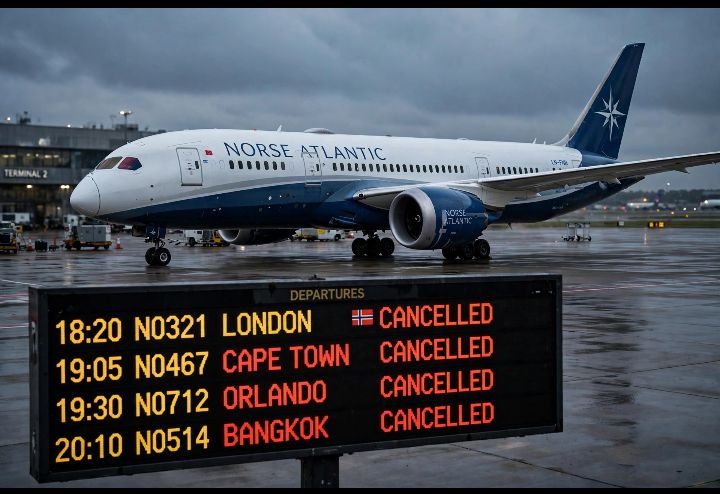
##Illustration: A Norse Atlantic Boeing 787 parked on a wet tarmac, with a departure board showing flights to London, Cape Town, Orlando and Bangkok as cancelled. Original illustration created for this article.
In three days, a budget long-haul airline went from warning of a critical cash crisis to grounding its entire fleet, and then to bankruptcy.
Norse Atlantic Airways, the Norwegian carrier that promised cheap long-haul flying between Europe, the United States, Asia and Africa, has cancelled all future flights and stopped selling tickets. Its Norwegian operating company has filed for bankruptcy.
For thousands of passengers booked for Christmas, for summer in Cape Town, for family trips to Orlando and Bangkok, the message is stark: your flight will not operate, and you must now find another way home or another way to get your money back.
What Happened, Day by Day
The collapse was not slow. It was brutally fast.
Wednesday, 25 November 2026: "Critical"
Norse Atlantic ASA told the Oslo Stock Exchange that its financial position was "critical". Its shares closed 85% lower that day. The company said it was in talks with investors about a possible takeover and with holders of its $52 million senior secured bonds.
It also cancelled flights that day, including a London Gatwick to Cape Town service, and suspended wet-lease operations for Pakistan International Airlines (PIA).
Thursday, 26 November 2026: All Flights Suspended
The next morning, Norse suspended all flights for the day. In a stock exchange announcement, it said:
"If a short-term financing solution is not secured urgently, it is the board's intention to file for bankruptcy."
The airline said it was still negotiating with investors, but warned there was no guarantee a deal would be reached. Hundreds of travellers were stranded in the United States, the United Kingdom and elsewhere on Thanksgiving Day in the US.
Friday, 27 November 2026: Bankruptcy Filed
By Friday morning, no rescue had materialised. The board of Norse Atlantic Airways AS, the Norwegian operating subsidiary, resolved to file a bankruptcy petition with the Agder District Court in Norway.
The company said: "Despite extensive efforts, the company has so far not been able to secure sufficient funding to meet its short-term liquidity needs."
On its website, the airline posted a simple, devastating notice:
"Norse Atlantic has stopped flying. All flights operated by Norse Atlantic Airways AS and Norse Atlantic UK Ltd from November 27th at 14.00 CET are cancelled. This includes return flights. Please do not go to the airport for a cancelled flight. Norse Atlantic Airways AS is going into an insolvency process."
Ticket sales were discontinued across the group.
What Exactly Filed for Bankruptcy?
This is an important distinction, because it affects who can claim what, and whether any part of Norse could return.
Filed for bankruptcy:
- Norse Atlantic Airways AS — the Norwegian operating company, which operated seven aircraft. This is the company now in insolvency. A bankruptcy trustee will be appointed by the Agder District Court to manage the process.
NOT part of this filing, at least for now:
- Norse Atlantic ASA — the listed parent company, traded on Euronext Expand Oslo.
- Norse Atlantic UK Ltd — the UK subsidiary, which operated five aircraft from London Gatwick and Manchester.
Chief Executive Eivind Roald said in a statement:
"The Board of Norse Atlantic Airways AS has made the difficult decision to file for bankruptcy despite extensive efforts from the Company and the Group to find a solution. We are deeply sorry for the impact this has on our passengers, employees and partners. The Board, management and advisers of the listed entity Norse Atlantic ASA and the UK subsidiary are working to find a solution for the remaining part of the business to continue operations."
Despite that hope, all Norse flights are cancelled, including those operated by the UK subsidiary. The UK Civil Aviation Authority (CAA) confirmed: "Norse Atlantic UK Limited (Norse), which operated scheduled services from Gatwick to Bangkok, Cape Town, Orlando and Phuket, has cancelled all flights."
Passengers should therefore assume, for now, that no Norse flight will operate, even if the parent company later finds a buyer for the UK unit.
Why Did Norse Collapse? Fuel Was the Final Blow
Norse Atlantic blamed soaring jet fuel prices triggered by the United States-Israel war on Iran.
Al Jazeera, drawing on Reuters reporting, put it bluntly: Norse has filed for bankruptcy for its main operating unit, cancelling all flights and halting ticket sales, as soaring jet fuel prices triggered by the war claim another operator.
Chief Executive Eivind Roald told Norwegian public broadcaster NRK:
"We were unable to absorb the extra cost … Fuel is what toppled this company."
The problem was not just that fuel got more expensive. It was that Norse had no protection against it.
"Many airlines hedge their fuel purchases and stockpile fuel to protect themselves against crises like this. Norse Atlantic did not hedge at all, so it had no protection against rising prices," aviation analyst John Strickland told Al Jazeera.
Fuel hedging is like insurance. Most large airlines buy fuel in advance at a fixed price, so a sudden spike does not instantly bankrupt them. Norse did not. When fuel prices doubled amid conflict in the Middle East, every flight became more expensive to operate than the ticket price could cover.
That was not the only pressure. The airline had already cut 75 jobs in May in a bid to save $50 million, cancelled more than 700 flights since the war began, dropped its Los Angeles summer schedule in April, and later announced it would pull its New York routes. It had also lost a lucrative six-aircraft wet-lease deal with India's IndiGo at the end of October 2026.
The final blow came on Friday, when the lessors of its Boeing 787 fleet issued termination notices for all of its aircraft. Norse said it was contesting the move, but analysts were clear: "It means Norse Atlantic is unlikely to continue operating because the lessors have terminated those contracts," Strickland said.
Norse operated a fleet of 12 Boeing 787 Dreamliners, leased from AerCap Holdings and BOC Aviation. It owned none of its aircraft. When the leases were terminated, it had no planes to fly, even if it had found cash.
Its shares fell nearly 69% on the Oslo Stock Exchange on Friday, bringing its losses this year to 99.86%. Its market capitalisation fell to just $2.4 million.
Norse is the second European airline to formally enter bankruptcy proceedings in 2026 after Latvia's airBaltic, highlighting the toll of the Iran war on carriers that entered the crisis without fuel hedges.
What The Filing Means For Passengers
If you are booked on a Norse flight, here is what the filing means in practical terms:
1. Your flight is cancelled, including your return flight.
Norse has been explicit: all flights are cancelled, including return flights. A one-way ticket home does not survive because you already flew out. You must book alternative travel.
2. Do not go to the airport for a Norse flight.
This is the airline's own advice, repeated by the UK CAA: "We urge passengers who were planning to fly with this airline not to go to the airport as all Norse flights are cancelled."
Airport staff cannot rebook you onto a Norse flight that does not exist.
3. Customer service is no longer available.
Norse said on its website that its customer service department is no longer available. That means you cannot call to be rebooked by the airline. You must pursue refunds through other channels.
4. A refund through Norse is possible, but not guaranteed.
Passengers can submit a claim as part of the insolvency process, but Norse noted that payment is not guaranteed.
In bankruptcy, passengers are typically unsecured creditors. Secured lenders, lessors, and employees are paid first. Passengers are often last. That does not mean you will get nothing, but it does mean you should not wait for Norse to refund you as your only plan.
5. Your best and fastest route is usually NOT Norse.
Both Norse and regulators advise passengers to check travel insurance or contact their bank or card issuer first. Those routes are faster and more likely to pay out than the bankruptcy court.
What Travellers Should Do Next
Based on what Norse, the UK CAA, and media reporting have said, follow this order:
Step 1: Do not travel to the airport for a Norse flight.
Unless you have already booked a replacement flight with another airline, stay home. Check your booking status on the Norse website first.
Step 2: If you still need to travel, book with another airline now.
Norse itself says: "If you still need to travel, look for a flight with another airline."
Prices will rise as seats fill, especially on the Cape Town, Orlando and Bangkok routes at peak season. The earlier you rebook, the cheaper the alternative is likely to be. One traveller rebooking a Cape Town trip with a different airline reported an extra cost of £1,000. Another, stranded in South Africa with her daughter, faced "a really expensive flight back."
Keep every receipt for replacement travel. You will need it for an insurance or card claim.
Step 3: Contact your bank or credit card issuer immediately.
This is the most important step for most passengers.
- If you paid by credit card and booked directly with Norse (UK passengers): You may be protected under Section 75 of the Consumer Credit Act 1974. The UK CAA said: "If you booked directly with Norse and paid by credit card you may be protected under Section 75... and should contact your card issuer."
- If you paid by debit card or credit card in other countries: Ask your bank about a chargeback. A chargeback reverses the payment when the service was not provided. Banks have time limits, so do not delay.
- If you paid via a third-party site or travel agent: Contact that agent first. They may have their own rebooking or refund process.
Step 4: Contact your travel insurer.
Norse advised customers to check their travel insurance or contact their banks. Many policies cover "scheduled airline failure" or "airline insolvency". Some do not. Check your policy wording, and file a claim as soon as possible. Provide your booking confirmation, proof of payment, and receipts for extra costs.
Step 5: File a claim in the insolvency process.
Norse said passengers could seek refunds through the bankruptcy process, but warned refunds were not guaranteed. It advised customers to check travel insurance or contact their banks.
You should still file. Norse said it will contact travellers with details on how to submit a claim. When that information appears on the Norse website, follow it. Filing does not stop you from also claiming via your bank or insurer, but tell each party about the other claim to avoid double-payment issues.
Step 6: Monitor official updates only.
Do not rely on social media rumours that Norse is "coming back next week". Check only:
- Norse Atlantic website: http://flynorse.com
- UK Civil Aviation Authority website: http://caa.co.uk
- Your country's aviation regulator, if you are outside the UK.
- The Agder District Court trustee announcements, once published.
The parent company says it is still seeking a solution for the UK subsidiary. If that changes, it will be announced on the Norse website and by the CAA, not by a WhatsApp forward.
Your Checklist: Affected Passengers
Keep this list. Do it today, not tomorrow.
- 1: Keep your tickets: Booking confirmation, ticket number, e-ticket PDF, and boarding pass if you already flew one way.
- 2: Keep proof of payment: Bank statement, credit card statement, or receipt showing amount, date, and who you paid.
- 3: Screenshot everything: Screenshot your Norse booking page, cancellation notice, and any email from Norse. The website may change.
- 4: Check refunds/changes: Contact your card issuer for Section 75 or chargeback, and your travel insurer for airline failure cover.
- 5: Book replacement travel if needed: Do not wait for Norse to rebook you. It will not.
- 6: Keep receipts for extra costs: New flights, extra hotel nights, meals, and transport. You may be able to claim them.
- 7: File an insolvency claim: When Norse publishes how to do it, file it, even if you have already claimed via your bank.
- 8: Do not go to the airport for a cancelled Norse flight.
- 9: Monitor official updates: Norse website and CAA website only.
Wider Impact: What This Means For African Flight Links
Norse was a small airline, but on one African route, it mattered a lot.
London Gatwick to Cape Town was Norse's key African link.
Norse launched the Gatwick to Cape Town route in October 2024 to compete with British Airways and Virgin Atlantic, which had the route to themselves.
In November 2026, Cirium schedule data showed 26 one-way flights planned between Gatwick and Cape Town that month alone, out of 122 total Norse flights. The airline had planned to increase the service to five flights a week this December, just in time for South Africa's summer peak season.
That expansion is now gone.
The timing could not be worse. The grounding happened at the start of the festive peak season. The African Travel and Tourism Association (ATTA) said: "The suspension of Norse Atlantic's flights is worrying for travellers on both sides of the London Gatwick–Cape Town route, especially those already away from home. The service has given travellers more choice on an important route between the UK and South Africa."
For South Africa, the impact is threefold:
1. Less choice, higher fares: With Norse gone, the Gatwick to Cape Town route returns to a British Airways and Virgin Atlantic duopoly. When a low-cost competitor disappears, fares on the remaining airlines tend to rise, especially at Christmas and New Year when demand is highest.
2. Stranded travellers and lost tourism: Travellers who had booked Norse for December holidays in Cape Town now face rebooking at much higher prices, or cancelling altogether. Some will cancel. That is lost hotel nights, lost safari bookings, lost restaurant spending, and lost income for guides, drivers, and guesthouses in the Western Cape.
3. A warning about low-cost long-haul: Norse proved again how hard it is to sustain low-fare intercontinental flying. Long-haul low-cost needs high aircraft utilisation, cheap fuel, and full planes. When fuel spikes, the model breaks first. African routes, which are long, fuel-heavy, and seasonal, are especially vulnerable.
Beyond Cape Town, the collapse also hit other connections that matter for Africa and Asia:
- Pakistan International Airlines (PIA): PIA relied on Norse for wet-leased aircraft on its UK routes. PIA said it would shift those operations to its own Boeing 777 fleet from 26 November after Norse abruptly suspended services, forcing the cancellation of two flights between London and Pakistan.
- P&O Cruises: P&O said its Caribbean fly-cruise trips were not affected for now, but it had to find alternative aircraft for charters Norse was operating.
- Thailand and the US: The same aircraft that flew to Cape Town also flew to Bangkok, Phuket, and Orlando. Those routes are also cancelled, reducing low-cost options for South African and other African travellers who used London as a hub to Asia and the US.
For now, there is no direct replacement for Norse on Gatwick to Cape Town. British Airways and Virgin Atlantic continue to fly the route, and South African Airways flies London Heathrow to Cape Town and Johannesburg. But none of them offered Norse's low fares.
If you are planning a UK to South Africa trip for December or January, book early, compare Heathrow and Gatwick options, and consider Johannesburg as an alternative entry point with a domestic connection to Cape Town if Gatwick fares spike.
What Happens Next?
Three things will happen in the coming weeks:
1. A trustee will take over. The Agder District Court will appoint a bankruptcy trustee to manage Norse Atlantic Airways AS. The trustee will sell assets, pay creditors in order of priority, and decide if any part of the business can be sold as a going concern. The estate will not continue flights under the Norse name.
2. The parent company will try to save the UK unit. Norse Atlantic ASA says it is working on a solution for the remaining business. That could mean a buyer for the UK subsidiary, or a new investor. But with all 12 aircraft leases terminated, any buyer would need to find aircraft, crews, and cash quickly. That is a very high hurdle.
3. Passengers will learn the hard lesson of airline bankruptcy. Unlike a normal cancellation, where an airline must rebook you or refund you under EU261 or UK261 rules, a bankrupt airline often cannot pay compensation. Your protection comes from your bank, your insurer, or your travel agent, not from the airline.
Norse Atlantic was founded in 2021, launched in 2022, and built its brand on a simple promise: long-haul flying should be affordable. For a while, it was. It won over thrifty travellers with cheap fares to Orlando, Bangkok, and Cape Town, even if it charged for blankets and earphones.
But cheap long-haul flying is one of the hardest businesses in the world. It needs cheap fuel, full planes, and no shocks. The war in Iran provided the shock. The lack of fuel hedging removed the cushion. The lessors taking back the planes removed the fleet.
The result is not just an airline failure. It is thousands of cancelled holidays, stranded families, and a reminder that the cheapest ticket can become the most expensive one if the airline behind it disappears.
If you are affected, act now: keep your tickets, contact your bank and insurer, book alternative travel if you must, and monitor only official updates. Do not wait for Norse to fix it. It cannot.
Sources: Al Jazeera, Reuters via The Guardian and other outlets, UK Civil Aviation Authority, Norse Atlantic ASA stock exchange announcement, 27 November 2026, African Travel and Tourism Association (ATTA), SA People, and Travel Weekly.
Where to check for updates: Norse Atlantic website (flynorse.com) and UK Civil Aviation Authority (caa.co.uk).
Version 1.0. 54gist stories are edited before publication and updated as facts change. Spotted an error? Tell our editors.