Kenyan Court Says Ebola Facility Needed More Public Input
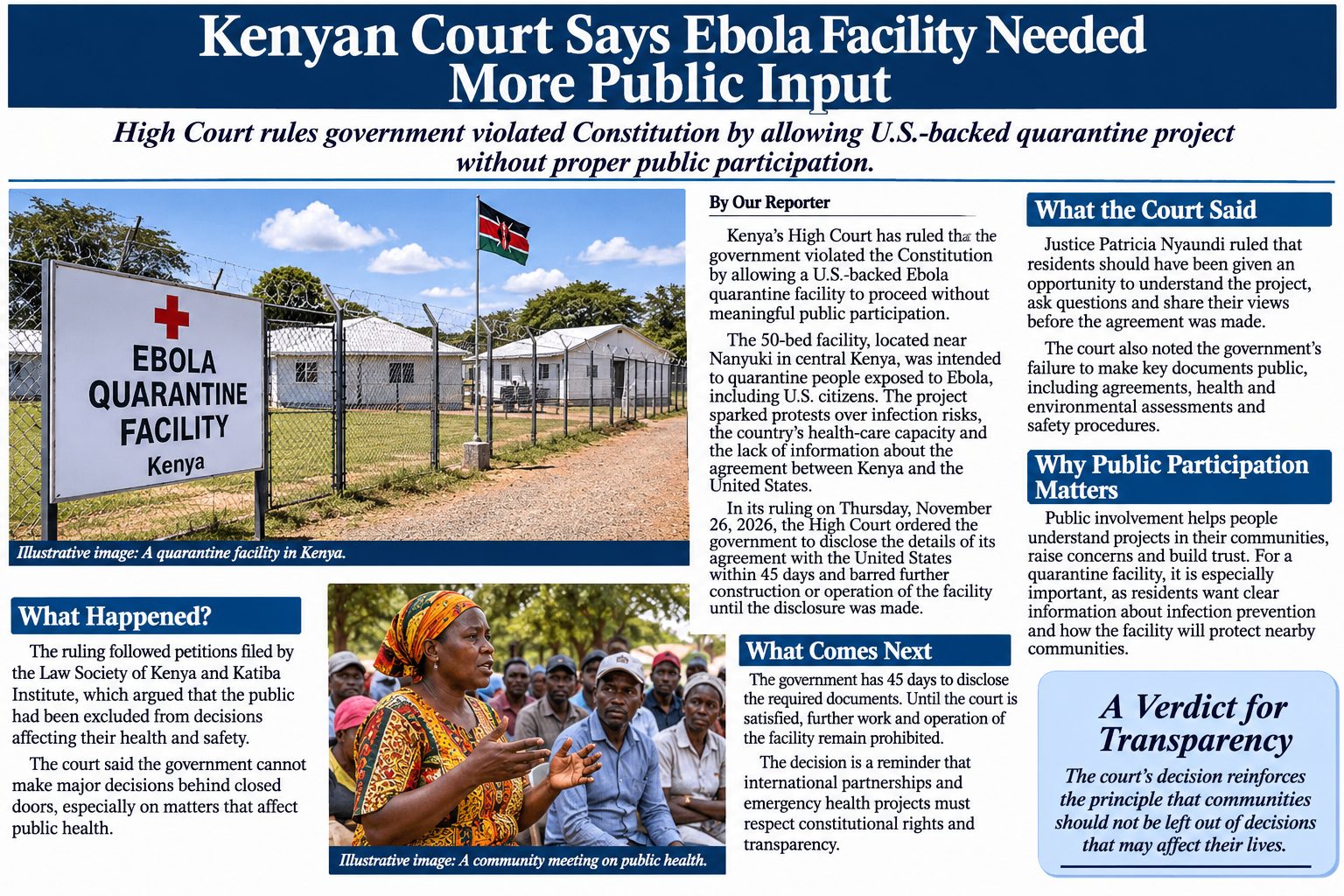
Kenyan Court Says Ebola Facility Needed More Public Input
Kenya’s High Court has ruled that the government violated the Constitution by allowing a U.S.-backed Ebola quarantine facility to proceed without proper public participation.
Kenya’s High Court has ruled that the government violated the Constitution by allowing the construction of a United States-backed Ebola quarantine facility at Laikipia Air Base without meaningful public participation.
The 50-bed facility, located near Nanyuki in central Kenya, was intended to quarantine people exposed to Ebola, including U.S. citizens. The project sparked protests among residents who raised concerns about possible infection risks, the country’s health-care capacity and the lack of information about the agreement between Kenya and the United States.
In its ruling on Thursday, November 26, 2026, the court ordered the government to disclose the details of its agreement with the United States within 45 days. It also prohibited further construction or operation of the facility until the required information had been disclosed and the court was satisfied with compliance.
What the court said
In plain terms, the court said the government cannot make major decisions affecting public health and local communities behind closed doors.
Justice Patricia Nyaundi ruled that residents should have been given an opportunity to understand the project, ask questions and contribute their views before the agreement was made.
The court also raised concerns about the continued failure to make relevant documents available, including agreements, health and environmental assessments, approvals and safety procedures.
The ruling followed petitions filed by the Law Society of Kenya and Katiba Institute, which challenged the project and argued that the public had been excluded from decisions affecting their health and safety.
Why public participation matters
Public participation is an important part of democratic governance. It allows people to understand projects planned in their communities and gives them an opportunity to raise concerns before decisions are implemented.
For a quarantine facility, public involvement is particularly important because residents may want clear information about infection prevention, emergency procedures, medical supervision and how the facility will protect nearby communities.
When authorities fail to communicate openly, fear and mistrust can grow. In Laikipia, concerns about the facility led to protests, some of which turned deadly.
The court’s decision therefore highlights the importance of transparency and accountability in public health projects. It also reinforces the principle that communities should not be left out of decisions that may affect their lives.
What the U.S. partnership involves
According to reporting by the Associated Press, the United States planned to contribute $13.5 million toward Kenya’s Ebola preparedness efforts.
The facility was intended to provide quarantine arrangements for people exposed to Ebola, including American citizens who had been working in affected areas. U.S. officials had said the arrangement would help provide care and reduce the risks associated with transporting exposed personnel over long distances.
However, questions remained about the full terms of the partnership, the safety arrangements and whether the facility would also serve Kenyan citizens exposed to the virus.
The court has now directed the government to make the relevant information public, allowing citizens and the judiciary to examine the agreement and its implications.
What comes next
The government has 45 days to disclose the required documents and information. Until the court is satisfied that the disclosure order has been complied with, further work and operation of the facility remain prohibited.
The ruling is a reminder that international partnerships and emergency health projects must respect constitutional rights and public accountability.
As Kenya continues to strengthen its response to Ebola and other public health threats, the challenge will be to protect lives while ensuring that communities are informed, consulted and treated as important partners in decisions affecting their health.
Sources: "Associated Press report" (https://apnews.com/article/9faf3d71819a9708b42c57e1a55aaa16) | "Katiba Institute court statement" (https://katibainstitute.org/high-court-rules-laikipia-ebola-quarantine-arrangement-unconstitutional/)
Sources
Version 1.0. 54gist stories are edited before publication and updated as facts change. Spotted an error? Tell our editors.